Sintered Bronze Bushings: Selection, Lubrication and Applications
Dec 13, 2025
A sintered bronze bushing is a porous sliding bearing manufactured from copper-based metal powder through compaction and sintering. After sintering, the interconnected pores can be filled with lubricating oil, allowing the bushing to store and release lubricant during operation.
```This combination of controlled porosity, oil retention, dimensional repeatability, and compact bearing geometry makes sintered bronze bushings suitable for motors, fans, household appliances, office equipment, power tools, automotive mechanisms, instruments, and other applications where frequent manual lubrication is difficult or undesirable.
```Technical note: A sintered bronze bushing is not automatically suitable for every load, speed, temperature, or dry-running condition. Its performance depends on material composition, density, porosity, oil type, shaft condition, running clearance, housing fit, alignment, contamination, and duty cycle.
What Is a Sintered Bronze Bushing?
```A sintered bronze bushing, also called an oil-impregnated bronze bushing or porous bronze bearing, is produced from bronze-based powder pressed into a near-net shape and heated in a controlled sintering atmosphere.
During sintering, the powder particles bond together while a controlled network of pores remains within the structure. These pores can subsequently be filled with lubricating oil. The finished component is installed between a rotating or oscillating shaft and its housing to support load, guide motion, reduce direct metal-to-metal contact, and provide a replaceable sliding surface.
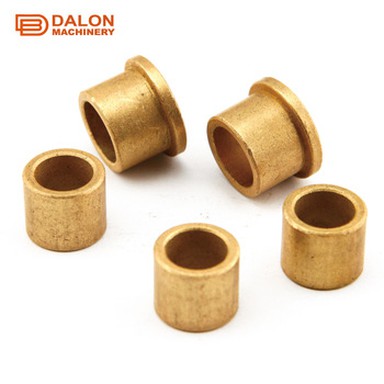
Sintered bronze bushings are commonly supplied as straight sleeves, flanged bushings, thrust washers, spherical bushings, stepped sleeves, and customized powder-metallurgy components.
```How Oil-Impregnated Bronze Bushings Work
```1. Lubricating oil is stored in the pores
After sintering and finishing, the porous bronze structure is impregnated with a selected lubricant. The oil occupies part of the interconnected pore volume.
2. Operation encourages oil migration
Shaft movement, pressure, capillary behavior, and operating temperature help move a small amount of lubricant toward the bearing surface.
3. A lubricating film reduces friction
The released oil forms a film between the shaft and bushing bore, helping reduce direct contact, heat generation, friction, and wear.
4. Part of the lubricant returns to the matrix
When motion stops or the component cools, part of the lubricant can be drawn back into the porous structure by capillary action.
Common Sintered Bronze Bushing Types
```| Bushing Type | Typical Characteristics | Common Applications |
|---|---|---|
| Straight sleeve bushing | Simple cylindrical shape used to support radial load and guide a shaft | Motors, fans, pumps, appliances, power tools, office equipment, and light mechanical assemblies |
| Flanged bronze bushing | Includes an integral flange for axial positioning and limited thrust support | Gearboxes, actuators, rollers, linkages, compact motors, and equipment requiring axial location |
| Thrust washer | Flat porous bearing component designed primarily for axial sliding contact | Small transmissions, rotating assemblies, appliances, actuators, and spacing applications |
| Spherical sintered bushing | Spherical outside geometry can assist with alignment in selected bearing assemblies | Fan motors, fractional-horsepower motors, and assemblies requiring limited self-alignment |
| Stepped or shouldered bushing | Includes multiple diameters, shoulders, grooves, or locating features | OEM mechanisms, special motors, power tools, transmission components, and customized assemblies |
| Customized sintered bronze part | Developed according to material, density, oil content, dimensions, load, speed, fit, and assembly requirements | Proprietary industrial equipment, automotive mechanisms, instruments, and application-specific bearing systems |
Dalon Machinery Co., Ltd.
```Dalon Machinery Co., Ltd. is a specialized manufacturer and exporter of powder-metallurgy components for sliding, filtration, pneumatic noise control, and industrial equipment applications. Since 2002, the company has developed oil-impregnated bronze bushings, iron-based bushings, sintered structural parts, porous filters, mufflers, and customized powder-metallurgy components.
Dalon's sintered bronze bushing projects may involve bronze-powder selection, density control, porosity, oil impregnation, dimensional sizing, bore finishing, flange design, grooves, shoulders, secondary machining, and integration with the customer's shaft and housing.
Customized projects can be reviewed according to drawings, samples, shaft dimensions, housing dimensions, radial load, axial load, speed, temperature, duty cycle, installation method, lubricant requirement, and target service life.
Before mass production, buyers should confirm the final drawing, material specification, density or porosity requirement, lubricant, dimensional tolerances, installed clearance, inspection method, packaging, and acceptance criteria.

Main Advantages of Sintered Bronze Bushings
```Oil Storage Capability
The porous bronze matrix can retain lubricant and supply it gradually to the sliding surface during suitable operating conditions.
Reduced Lubrication Frequency
Oil impregnation can reduce the need for frequent manual lubrication in applications that remain within the bushing's operating limits.
Repeatable Dimensions
Powder compaction and sizing support repeatable geometry for medium- and high-volume production.
Good Thermal Conductivity
Bronze-based materials can transfer frictional heat away from the local contact area when the surrounding assembly supports heat dissipation.
Compact Bearing Design
A thin and simple sleeve can provide a practical sliding-bearing solution where installation space is limited.
Efficient Material Use
Near-net-shape powder metallurgy can reduce machining and material loss for suitable part geometries and production volumes.
Sintered Bronze Bushings Are Different from Solid Bronze Bushings
```A sintered bronze bushing contains controlled interconnected porosity and is commonly oil impregnated. Its design is based on retaining lubricant inside the bearing matrix and supplying it to the shaft interface during operation.
A solid bronze bushing is normally produced by casting, centrifugal casting, extrusion, or machining. It has a denser structure and usually relies on grease grooves, oil grooves, external lubrication, embedded solid lubricant, or another lubrication system.
Solid bronze bushings may be selected for certain high-load, impact, large-diameter, or heavily machined applications. Sintered bronze bushings are often more suitable for compact, repeat-production components where oil retention, low maintenance, and dimensional repeatability are important.
The two product families should not be substituted based only on dimensions. Load, speed, lubrication, operating temperature, impact, contamination, alignment, and service-life expectations must be reviewed.
```Key Factors When Selecting a Sintered Bronze Bushing
```| Selection Factor | What Buyers Should Confirm |
|---|---|
| Load | Radial load, axial load, peak load, shock load, load direction, and whether the load is continuous or intermittent |
| Motion type | Continuous rotation, intermittent rotation, oscillation, reciprocation, startup frequency, and duty cycle |
| Shaft speed | Normal speed, maximum speed, startup behavior, and whether the operating condition can maintain an adequate lubricant film |
| Material and density | Bronze composition, density, pore volume, mechanical strength, and compatibility with the intended lubricant |
| Lubricating oil | Oil viscosity, temperature range, oxidation stability, compatibility with seals or plastics, and application requirements |
| Shaft condition | Shaft material, hardness, surface finish, roundness, corrosion resistance, and dimensional tolerance |
| Housing fit | Housing bore, interference fit, wall thickness, press-fitting method, and dimensional change after installation |
| Operating environment | Temperature, moisture, dust, chemicals, vibration, contamination, storage conditions, and corrosion exposure |
| Expected service life | Required operating hours, allowable wear, maintenance access, replacement interval, and validation method |
Running Clearance and Press Fit
```The internal diameter of a sintered bronze bushing may decrease after it is pressed into the housing. The final running clearance should therefore be evaluated after installation, not only from the free-state dimensions of the bushing.
If the housing interference is excessive, the bushing bore may contract too much, increasing friction and the risk of seizure. If the interference is insufficient, the bushing may rotate or move inside the housing.
Suitable chamfers, pressing tools, alignment, and controlled installation force help prevent cracking, deformation, pore damage, and loss of dimensional accuracy.
```Shaft Requirements
```The shaft surface has a direct influence on friction and bushing life. A shaft that is rough, damaged, corroded, undersized, oversized, or insufficiently hard can cause rapid wear even when the bushing itself meets the drawing.
The selected shaft material and surface finish should support lubricant-film formation and avoid excessive abrasion of the porous bronze surface. Shaft straightness and alignment are also important because edge loading can produce uneven wear and local overheating.
For critical applications, the shaft, bushing, housing, lubricant, load, and installation method should be validated together as one bearing system.
```Common Failure Modes
```| Failure Mode | Possible Causes | Points to Check |
|---|---|---|
| Rapid bore wear | Rough shaft, abrasive contamination, insufficient lubrication, excessive load, poor alignment, or unsuitable material | Shaft finish, lubricant, seals, load, alignment, clearance, and operating environment |
| Seizure or overheating | Running clearance too small, oil loss, excessive speed, overload, thermal expansion, or installation distortion | Installed bore, shaft size, temperature, speed, oil condition, and press fit |
| Oil loss | Excessive temperature, unsuitable oil viscosity, prolonged storage, solvent exposure, or incorrect cleaning | Oil specification, temperature, storage, cleaning process, packaging, and operating time |
| Cracking during installation | Excessive interference, poor housing chamfer, impact installation, misalignment, or unsuitable pressing tool | Housing tolerance, assembly tooling, press force, bushing wall thickness, and installation method |
| Bushing rotation in the housing | Insufficient interference, excessive friction torque, housing wear, thermal cycling, or improper housing material | Housing bore, press fit, operating torque, temperature, and retention method |
| Uneven wear | Shaft misalignment, housing distortion, edge loading, bent shaft, or uneven load distribution | Alignment, shaft straightness, housing geometry, contact pattern, and assembly rigidity |
Information to Include in Your RFQ
```A reliable quotation requires more than the inside diameter, outside diameter, and length. Buyers should provide the following information whenever possible:
- 2D drawing, 3D model, sample, photograph, or assembly information
- Bushing type: straight, flanged, thrust, spherical, stepped, or customized
- Inside diameter, outside diameter, length, flange dimensions, grooves, holes, and critical tolerances
- Preferred bronze material, density, porosity, or oil-content requirements
- Required lubricant or operating-temperature range
- Shaft material, shaft hardness, surface finish, and shaft tolerance
- Housing material, housing bore tolerance, and installation method
- Radial load, axial load, shock load, and load direction
- Rotational speed, oscillation angle, reciprocating motion, and duty cycle
- Normal and maximum operating temperature
- Exposure to moisture, dust, chemicals, vibration, or abrasive particles
- Target service life, allowable wear, inspection method, and acceptance criteria
- Sample quantity, annual demand, and expected project schedule
- Packaging, labeling, material reports, traceability, or certification requirements
Common Sourcing Mistakes
```Comparing by dimensions only
Two bushings with identical dimensions may have different bronze composition, density, porosity, lubricant, strength, friction, and service life.
Treating self-lubricating as maintenance-free
Oil-impregnated bushings still have operating limits related to load, speed, temperature, contamination, oil loss, alignment, and duty cycle.
Ignoring the installed inside diameter
Press fitting can reduce the bore diameter. Insufficient final clearance may cause excessive friction, heat, or seizure.
Using an unsuitable shaft surface
A shaft that is rough, soft, corroded, misaligned, or dimensionally unstable can cause premature bushing wear.
Selecting oil without considering temperature
Oil viscosity and stability change with temperature. An unsuitable lubricant can reduce startup performance, oil-film formation, or long-term service life.
Skipping installed-condition testing
Samples should be evaluated after press fitting for clearance, friction, noise, temperature rise, oil behavior, wear, and assembly performance.
How to Evaluate a Sintered Bronze Bushing Manufacturer
```A capable manufacturer should review the application, drawing, bronze material, density, porosity, oil type, shaft, housing, press fit, running clearance, load, speed, temperature, and target service life before recommending a design.
Buyers should evaluate whether the supplier can control powder composition, compaction, sintering, sizing, oil impregnation, bore dimensions, flange geometry, secondary machining, inspection, and batch consistency.
The most suitable manufacturing partner is not necessarily the supplier with the lowest unit price. Dimensional stability, oil-content consistency, tooling control, installation support, corrective-action capability, delivery reliability, and technical communication can have a greater effect on total operating cost.
```Discuss Your Sintered Bronze Bushing Project with Dalon
```Dalon Machinery supports standard and customized sintered bronze bushings for motors, fans, appliances, power tools, office equipment, automotive mechanisms, instruments, and industrial sliding applications.
To receive a more accurate technical evaluation, please provide the drawing, shaft and housing dimensions, bronze material, load, speed, lubricant, temperature, installation method, target service life, sample demand, and expected quantity.
```