Sintered Metal Filter Manufacturers in China: A Buyer’s Selection Guide
Jun 13, 2026
Sintered metal filters are widely used in gas and liquid filtration, flow control, gas diffusion, sensor protection, pneumatic exhaust systems, chemical processing, water treatment, and other demanding industrial applications. Because performance depends on material selection, pore structure, filtration rating, mechanical strength, flow resistance, and operating conditions, selecting a suitable manufacturer requires more than comparing product photos or quoted prices.
```This guide highlights the technical and commercial factors industrial buyers should evaluate when selecting a sintered metal filter manufacturer in China. It also outlines Dalon Machinery's capabilities in powder-sintered metal and porous plastic components.
Technical note: Filtration ratings, pore sizes, flow rates, pressure-drop values, and temperature limits should always be confirmed according to the actual medium and operating conditions. Published specifications should not replace application testing.
What Should Buyers Compare?
```A reliable supplier evaluation should cover both manufacturing capability and application support. The following questions can help buyers identify whether a manufacturer is suitable for a standard component, a customized porous part, or a technically demanding filtration project.
| Evaluation Area | Questions to Ask |
|---|---|
| Material capability | Can the supplier manufacture bronze, stainless steel, nickel alloy, titanium, PE, PTFE, or other porous materials suitable for the application? |
| Filtration and pore control | How are filtration grade, pore-size distribution, bubble point, permeability, and flow consistency controlled and verified? |
| Product geometry | Are discs, tubes, cups, cones, cartridges, plates, mufflers, threaded parts, or custom-molded components available? |
| Application engineering | Can the supplier recommend a suitable material and filtration grade based on the fluid, temperature, pressure, flow rate, particle size, and cleaning method? |
| Testing capability | Can the supplier provide dimensional inspection, flow testing, bubble-point testing, pressure testing, mechanical testing, or material documentation? |
| Customization | Can the manufacturer work from drawings, samples, target flow values, installation constraints, connection requirements, or customer-specific assemblies? |
| Commercial suitability | Are sample quantities, tooling costs, MOQ, production lead times, packaging requirements, payment terms, and export documentation clearly defined? |
| Batch consistency | How does the supplier control dimensional tolerances, porosity, filtration performance, and flow variation between production batches? |
Dalon Machinery Co., Ltd.
```Dalon Machinery manufactures powder metallurgy components for industrial filtration, flow control, gas diffusion, pneumatic exhaust noise reduction, equipment protection, and related industrial applications. Its product range includes sintered metal filters, sintered plastic filters, porous discs, tubes, cartridges, caps, mufflers, and customized porous components.
The company works with materials such as stainless steel, bronze, polyethylene, and other application-specific porous materials. Custom projects may involve material selection, pore or filtration grade, dimensions, structural design, connection type, flow performance, pressure-drop requirements, and integration with the customer's assembly.
Dalon may be suitable for buyers seeking customized powder metallurgy components, flexible project development, and combined support for filtration, diffusion, flow control, venting, and pneumatic exhaust applications. Buyers should provide actual operating conditions and target performance requirements when requesting a technical evaluation.
For customized products, the final material, dimensions, filtration grade, flow characteristics, allowable pressure drop, and testing criteria should be confirmed through drawings, samples, or technical specifications before mass production.

Powder-Sintered Filters and Sintered Mesh Filters Are Not the Same
```One common sourcing mistake is treating all products described as "sintered metal filters" as equivalent. In practice, manufacturers may specialize in different filtration media, manufacturing processes, structures, and operating conditions.
Before requesting a quotation, buyers should first identify whether the application requires a powder-sintered component, a sintered wire-mesh structure, a metal-fiber medium, or a combined filtration assembly.
| Filter Type | Typical Characteristics | Common Selection Considerations |
|---|---|---|
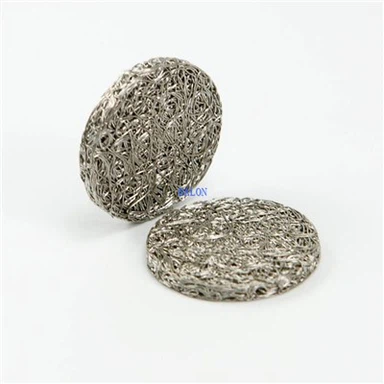
| Powder-sintered metal | Rigid and self-supporting porous structure, controlled permeability, compact geometries, and potential depth-filtration capability | Powder material, particle form, pore structure, mechanical strength, flow resistance, filtration grade, and cleaning method |
| Sintered wire mesh | Layered woven structure, good dimensional stability, and suitability for many surface-filtration and backwashing applications | Mesh construction, layer arrangement, filtration rating, support structure, forming process, welding quality, and sealing method |
| Metal fiber felt | High porosity, comparatively large dirt-holding capacity, and suitability for pleated elements with a larger effective filtration area | Fiber diameter, media thickness, pleat structure, pressure drop, thermal compatibility, chemical resistance, and cleaning requirements |
| Porous plastic filter | Lightweight porous structure with corrosion resistance and suitability for selected gas, liquid, venting, and fluid-management applications | Polymer type, chemical compatibility, operating temperature, dimensional stability, pore grade, and sterilization or cleaning method |
Important Technical Factors Before Selecting a Filter
```Filtration Rating
Clarify whether the stated value refers to a nominal filtration rating, an absolute rating, an average pore size, or another test-based parameter.
Pressure Drop
Pressure loss depends on pore structure, filter thickness, effective area, fluid viscosity, flow rate, contamination level, and operating temperature.
Mechanical Strength
The filter must withstand the normal operating pressure, differential pressure, vibration, assembly load, and possible pressure spikes.
Chemical Compatibility
Material selection should consider the process medium, concentration, exposure duration, temperature, cleaning chemicals, and possible corrosion mechanisms.
Cleaning and Regeneration
Determine whether the filter will be replaced, backwashed, ultrasonically cleaned, chemically cleaned, steam cleaned, or regenerated by another method.
Batch Repeatability
For repeat orders, dimensional tolerances, permeability, flow, pore characteristics, and assembly performance should remain within agreed acceptance limits.
Information to Include in Your RFQ
```A supplier cannot reliably recommend a filter based only on its length, diameter, and micron rating. For a more accurate quotation and technical assessment, buyers should provide the following information whenever possible:
- Filtration medium: gas, compressed air, water, oil, solvent, chemical solution, steam, powder, or another process medium
- Material and chemical-compatibility requirements
- Normal operating temperature and maximum temperature
- Normal operating pressure and maximum differential pressure
- Required filtration rating, pore grade, or target particle size
- Target flow rate and acceptable pressure drop
- Filter dimensions, dimensional tolerances, connection type, and installation method
- Direction of flow and available effective filtration area
- Expected cleaning method, including backwashing, ultrasonic cleaning, solvent cleaning, steam cleaning, or replacement
- Required quantity, annual demand, sample quantity, and expected project schedule
- Drawings, 3D files, photographs, existing samples, or assembly information
- Applicable inspection, documentation, certification, packaging, or traceability requirements
How to Choose the Right Manufacturer
```There is no single manufacturer that is automatically the best choice for every filtration project. A supplier experienced in compact powder-sintered components may not be the best fit for a large pleated cartridge. A company focused on complete filtration systems may be less competitive for a small custom porous insert.
The most suitable manufacturer is the one whose material capability, production process, testing method, customization scope, order size, and engineering support match the actual operating conditions of the application.
Buyers should also evaluate the quality of technical communication. A capable supplier should ask questions about the process medium, temperature, pressure, flow, filtration objective, dimensions, cleaning method, and acceptance criteria instead of quoting only according to a photograph.
Before placing a production order, buyers should request technical confirmation, drawings, samples, inspection criteria, and clearly defined acceptance requirements. For critical applications, performance should be validated under conditions as close as possible to the intended operating environment.
```Recommended Supplier Evaluation Process
```1. Define the operating conditions
Confirm the process medium, temperature, pressure, flow, target particle size, allowable pressure drop, dimensions, and expected service life.
2. Compare technical responses
Evaluate whether each supplier explains its proposed material, filter grade, manufacturing process, limitations, testing method, and expected performance.
3. Approve drawings and samples
Confirm dimensions, tolerances, interfaces, appearance, flow performance, filtration criteria, and inspection requirements before mass production.
4. Validate under actual conditions
Whenever practical, test samples using the actual medium, pressure, temperature, flow, installation structure, and cleaning cycle.
5. Define mass-production acceptance criteria
Agree on inspection methods, sampling plans, allowable variation, documentation, packaging, labeling, traceability, and corrective-action procedures.
Discuss Your Sintered Filter Application with Dalon
```Dalon Machinery supports standard and customized sintered filter projects involving stainless steel, bronze, porous plastic, and other powder metallurgy components. To receive a more useful technical response, please provide your medium, temperature, pressure, flow requirement, filtration grade, dimensions, connection method, cleaning method, and expected quantity.
Drawings, samples, photographs, assembly information, and target performance data can help shorten the evaluation process and improve quotation accuracy.
```